Mastigonemes are lateral "hairs" that attach to protistan flagella. Flimsy hairs attach to the flagella of euglenid flagellates, while stiff hairs occur in stramenopile and cryptophyte protists.[1] Stramenopile hairs are approximately 15 nm in diameter, and usually consist of flexible basal part that inserts into the cell membrane, a tubular shaft that itself terminates in smaller "hairs". They reverse the thrust caused when a flagellum beats. The consequence is that the cell is drawn into the water and particles of food are drawn to the surface of heterotrophic species.

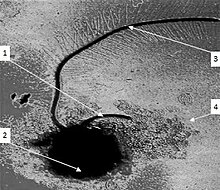
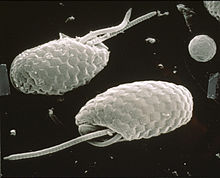
Typology of flagella with hairs:[2][3][4][5][6]
- whiplash flagella (= smooth, acronematic flagella): without hairs but may have extensions , e.g., in Opisthokonta
- hairy flagella (= tinsel, flimmer, pleuronematic flagella): with hairs (= mastigonemes sensu lato), divided in:
- with fine hairs (= non tubular, or simple hairs): occurs in Euglenophyceae, Dinoflagellata, some Haptophyceae (Pavlovales)
- with stiff hairs (= tubular hairs, retronemes, mastigonemes sensu stricto), divided in:
- bipartite hairs: with two regions. Occurs in Cryptophyceae, Prasinophyceae, and some Heterokonta
- tripartite (= straminipilous) hairs: with three regions (a base, a tubular shaft, and one or more terminal hairs). Occurs in most Heterokonta/Stramenopiles
Observations of mastigonemes using light microscopy dates from the nineteenth century.[7][8][9][10][11] Considered artifacts by some, their existence would be confirmed with electron microscopy.[12][13]