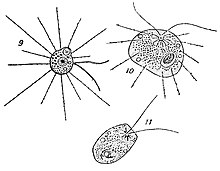
The Heliomonadida[1] (formerly Dimorphida[2]) are a small group of heliozoan amoeboids that are unusual in possessing flagella throughout their life cycle.

Classification
Genetic studies place them among the Cercozoa, a group including various other flagellates that form filose pseudopodia. This order has recently been placed into the new class of naked filose cercozoans called Granofilosea.[1] There are two genera in this order:
- Heliomorpha, a tiny organism found in freshwater
- the larger Tetradimorpha, which is distinguished by having four rather than two flagella.
Morphology
Bundles of microtubules, typically in square array, arise from a body near the flagellar bases and support the numerous axopods that project from the cell surface.
Dimorphids have a single nucleus, and mitochondria with tubular cristae.