A harmful algal bloom (HAB) (or excessive algae growth) is an algal bloom that causes negative impacts to other organisms via production of natural algae-produced toxins, mechanical damage to other organisms, or by other means. HABs are sometimes defined as only those algal blooms that produce toxins, and sometimes as any algal bloom that can result in severely lower oxygen levels in natural waters, killing organisms in marine or fresh waters.[1] Blooms can last from a few days to many months. After the bloom dies, the microbes that decompose the dead algae use up more of the oxygen, generating a "dead zone" which can cause fish die-offs. When these zones cover a large area for an extended period of time, neither fish nor plants are able to survive. Harmful algal blooms in marine environments are often called "red tides".[2][3]

It is sometimes unclear what causes HABs; their occurrence in some locations appears to be entirely natural,[4] while in others they appear to be a result of human activities.[5] In certain locations there are links to particular drivers like nutrients, but HABs have also been occurring since before humans started to affect the environment. HABs are induced by eutrophication, which is an overabundance of nutrients in the water. The two most common nutrients are fixed nitrogen (nitrates, ammonia, and urea) and phosphate.[6] The excess nutrients are emitted by agriculture, industrial pollution, excessive fertilizer use in urban/suburban areas, and associated urban runoff. Higher water temperature and low circulation also contribute.
HABs can cause significant harm to animals, the environment and economies. They have been increasing in size and frequency worldwide, a fact that many experts attribute to global climate change. The U.S. National Oceanic and Atmospheric Administration (NOAA) predicts more harmful blooms in the Pacific Ocean.[7] Potential remedies include chemical treatment, additional reservoirs, sensors and monitoring devices, reducing nutrient runoff, research and management as well as monitoring and reporting.
Terrestrial runoff, containing fertilizer, sewage and livestock wastes, transports abundant nutrients to the seawater and stimulates bloom events. Natural causes, such as river floods or upwelling of nutrients from the sea floor, often following massive storms, provide nutrients and trigger bloom events as well. Increasing coastal developments and aquaculture also contribute to the occurrence of coastal HABs.[2][3] Effects of HABs can worsen locally due to wind driven Langmuir circulation and their biological effects.
Description and identification

HABs from cyanobacteria (blue-green algae) can appear as a foam, scum, or mat on or just below the surface of water and can take on various colors depending on their pigments.[6] Cyanobacteria blooms in freshwater lakes or rivers may appear bright green, often with surface streaks which looks like floating paint.[8] Cyanobacterial blooms are a global problem.[9]
Most blooms occur in warm waters with excessive nutrients.[6] The harmful effects from such blooms is due to the toxins they produce or from using up oxygen in the water which can lead to fish die-offs.[10] Not all algal blooms produce toxins, however, with some only discoloring water, producing a smelly odor, or adding a bad taste to the water. Unfortunately, it is not possible to tell if a bloom is harmful from just appearances, since sampling and microscopic examination is required.[6] In many cases microscopy is not sufficient to tell the difference between toxic and non-toxic populations. In these cases, tools can be employed to measure the toxin level or to determine if the toxin-production genes are present.[11]
Terminology
In a narrow definition, harmful algal blooms are only those blooms that release toxins that affect other species. On the other hand, any algal bloom can cause dead zones due to low oxygen levels, and could therefore be called "harmful" in that sense. The usage of the term "harmful algal blooms" in the media and scientific literature is varied. In a broader definition, all "organisms and events are considered to be HABs if they negatively impact human health or socioeconomic interests or are detrimental to aquatic systems".[12] A harmful algal bloom is "a societal concept rather than a scientific definition".[12]
A similarly broad definition of HABs was adopted by the US Environmental Protection Agency in 2008 who stated that HABs include "potentially toxic (auxotrophic, heterotrophic) species and high-biomass producers that can cause hypoxia and anoxia and indiscriminant mortalities of marine life after reaching dense concentrations, whether or not toxins are produced".[1]
Red tide
Harmful algal bloom in coastal areas are also often referred to as "red tides".[12] The term "red tide" is derived from blooms of a species of dinoflagellate.[13] However, the term is misleading since algal blooms can widely vary in color, and growth of algae is unrelated to the tides. Not all red tides are produced by dinoflagellates. The mixotrophic ciliate Mesodinium rubrum produces non-toxic blooms coloured deep red by chloroplasts it has enslaved from the algae it eats. [14]

As a technical term, it is being replaced in favor of more precise terminology, including the generic term "harmful algal bloom" for harmful species, and "algal bloom" for benign species.
Types
There are three main types of phytoplankton which can form into harmful algal blooms: cyanobacteria, dinoflagellates and diatoms. All three are made up of microscopic floating organisms which, like plants, can create their own food from sunlight by means of photosynthesis. That ability makes the majority of them an essential part of the food web for small fish and other organisms.[15]: 246
Cyanobacteria
Harmful algal blooms in freshwater lakes and rivers, or at estuaries, where rivers flow into the ocean, are caused by cyanobacteria, which are commonly referred to as "blue-green algae",[16] but are in fact prokaryotic bacteria,[17] as opposed to algae which are eukaryotes.[18] Some cyanobacteria, including the widespread genus Microsystis, can produce hazardous cyanotoxins such as microcystins,[19] which are hepatotoxins that target the liver of mammals.[20] Other types of cyanobacteria can also produce hepatoxins, as well as neurotoxins, cytotoxins, and endotoxins.[21] Water purification plants may be unable to remove these toxins, leading to increasingly common localised advisories against drinking tap water, as happened in Toledo, Ohio in August 2014.[22]
In August 2021, there were 47 lakes confirmed to have algal blooms in New York State alone.[23][24] In September 2021, Spokane County’s Environmental Programs issued a HAB alert for Newman Lake following tests showing potentially harmful toxicity levels for cyanobacteria,[25] while in the same month record-high levels of microcystins were reported leading to an extended 'Do Not Drink' advisory for 280 households at Clear Lake, California's second-largest freshwater lake.[26] Water conditions in Florida, meanwhile, continue to deteriorate under increasing nutrient inflows, causing severe HAB events in both freshwater and marine areas.[27]
HABs also cause harm by blocking the sunlight used by plants and algae to photosynthesise, or by depleting the dissolved oxygen needed by fish and other aquatic animals, which can lead to fish die-offs.[10] When such oxygen-depleted water covers a large area for an extended period of time, it can become hypoxic or even anoxic; these areas are commonly called dead zones. These dead zones can be the result of numerous different factors ranging from natural phenomenon to deliberate human intervention, and are not just limited to large bodies of fresh water as found in the great lakes, but are also prone to bodies of salt water as well.[28]
Dual-stage life systems of algal species
Many of the species that form harmful algae blooms will undergo a dual-stage life system. These species will alternate between a benthic resting stage and a pelagic vegetative state. The benthic resting stage corresponds to when these species are resting near the ocean floor. In this stage, the species cells are waiting for optimal conditions so that they can move towards the surface. These species will then transition from the benthic resting stage into the pelagic vegetative state - where they are more active and found near the water body surface. In the pelagic vegetative state, these cells are able to grow and multiply. It is within the pelagic vegetative state that a bloom is able to occur - as the cells rapidly reproduce and take over the upper regions of the body of water. The transition between these two life stages can have multiple effects on the algae bloom (such as rapid termination of the HAB as cells convert from the pelagic state to the benthic state). Many of the algal species that undergo this dual-stage life cycle are capable of rapid vertical migration. This migration is required for the movement from the benthic area of bodies of water to the pelagic zone. These species require immense amounts of energy as they pass through the various thermoclines, haloclines, and pycnoclines that are associated with the bodies of water in which these cells exist.[29]
Diatoms and dinoflagellates (in marine coastal areas)
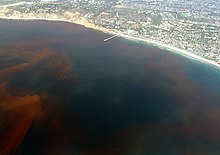
The other types of algae are diatoms and dinoflagellates, found primarily in marine environments, such as ocean coastlines or bays, where they can also form algal blooms. Coastal HABs are a natural phenomenon,[30][31] although in many instances, particularly when they form close to coastlines or in estuaries, it has been shown that they are exacerbated by human-induced eutrophication and/or climate change.[32][33][34][35] They can occur when warmer water, salinity, and nutrients reach certain levels, which then stimulates their growth.[30] Most HAB algae are dinoflagellates.[36] They are visible in water at a concentration of 1,000 algae cells/ml, while in dense blooms they can measure over 200,000/ml.[37]
Diatoms produce domoic acid, another neurotoxin, which can cause seizures in higher vertebrates and birds as it concentrates up the food chain.[38] Domoic acid readily accumulates in the bodies of shellfish, sardines, and anchovies, which if then eaten by sea lions, otters, cetaceans, birds or people, can affect the nervous system causing serious injury or death.[38] In the summer of 2015, the state governments closed important shellfish fisheries in Washington, Oregon and California because of high concentrations of domoic acid in shellfish.[39]
In the marine environment, single-celled, microscopic, plant-like organisms naturally occur in the well-lit surface layer of any body of water. These organisms, referred to as phytoplankton or microalgae, form the base of the food web upon which nearly all other marine organisms depend. Of the 5000+ species of marine phytoplankton that exist worldwide, about 2% are known to be harmful or toxic.[40] Blooms of harmful algae can have large and varied impacts on marine ecosystems, depending on the species involved, the environment where they are found, and the mechanism by which they exert negative effects.
List of common HAB genera
- Gonyaulax
- Karenia
- Gymnodinium
- Dinophysis
- Noctiluca
- Chattonella
- Ceratium
- Amoebophyre
- Alexandrium
- Cochlodinium
Causes

It is sometimes unclear what causes HABs; their occurrence in some locations appears to be entirely natural,[4] while in others they appear to be a result of human activities.[5] Furthermore, there are many different species of algae that can form HABs, each with different environmental requirements for optimal growth. The frequency and severity of HABs in some parts of the world have been linked to increased nutrient loading from human activities. In other areas, HABs are a predictable seasonal occurrence resulting from coastal upwelling, a natural result of the movement of certain ocean currents.[42]
The growth of marine phytoplankton (both non-toxic and toxic) is generally limited by the availability of nitrates and phosphates, which can be abundant in coastal upwelling zones as well as in agricultural run-off. The type of nitrates and phosphates available in the system are also a factor, since phytoplankton can grow at different rates depending on the relative abundance of these substances (e.g. ammonia, urea, nitrate ion).[43]
A variety of other nutrient sources can also play an important role in affecting algal bloom formation, including iron, silica or carbon. Coastal water pollution produced by humans (including iron fertilization) and systematic increase in sea water temperature have also been suggested as possible contributing factors in HABs.[43]
Among the causes of algal blooms are:[44]
- Excess nutrients—phosphorus and nitrates—from fertilizers or sewage that are discharged to water bodies (also called nutrient pollution)[45][16][46]
- climate change[45]
- thermal pollution from power plants and factories
- low water levels in inland waterways and lakes, which reduces water flow and increases water temperatures[20][47]
- invasive filter feeders—especially Zebra mussels, Dreissena polymorpha—which preferentially eat non-toxic algae, competitors to harmful algae[48]
Nutrients
Nutrients enter freshwater or marine environments as surface runoff from agricultural pollution and urban runoff from fertilized lawns, golf courses and other landscaped properties; and from sewage treatment plants that lack nutrient control systems.[49] Additional nutrients are introduced from atmospheric pollution.[50] Coastal areas worldwide, especially wetlands and estuaries, coral reefs and swamps, are prone to being overloaded with those nutrients.[50] Most of the large cities along the Mediterranean Sea, for example, discharge all of their sewage into the sea untreated.[50] The same is true for most coastal developing countries, while in parts of the developing world, as much as 70% of wastewater from large cities may re-enter water systems without being treated.[51]
Residual nutrients in treated wastewater can also accumulate in downstream source water areas[52] and fuel eutrophication, which leads progressively to a cyanobacteria-dominated system characterized by seasonal HABS. As more wastewater treatment infrastructure is built, more treated wastewater is returned to the natural water system, leading to a significant increase in these residual nutrients.
Residual nutrients combine with nutrients from other sources to increase the sediment nutrient stockpile that is the driving force behind phase shifts to entrenched eutrophic conditions.
This contributes to the ongoing degradation of dams, lakes, rivers, and reservoirs - source water areas that are starting to become known as ecological infrastructure,[53] placing increasing pressure on wastewater treatment works and water purification plants. Such pressures, in turn, intensify seasonal HABs.
Climate change
Climate change contributes to warmer waters which makes conditions more favorable for algae growth in more regions and farther north.[54][45] In general, still, warm, shallow water, combined with high-nutrient conditions in lakes or rivers, increases the risk of harmful algal blooms.[47]
Warming of summer surface temperatures of lakes, which rose by 0.34 °C decade per decade between 1985 and 2009 due to global warming, also will likely increase algal blooming by 20% over the next century.[55]
The IPCC Sixth Assessment Report published in 2022 found that: "Warming directly affects thermal water regimes, promoting harmful algal blooms".[56]: 4–39
Causes or contributing factors of coastal HABs
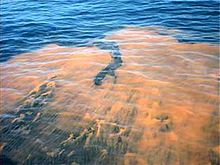
HABs contain dense concentrations of organisms and appear as discolored water, often reddish-brown in color. It is a natural phenomenon, but the exact cause or combination of factors that result in a HAB event are not necessarily known.[57] However, three key natural factors are thought to play an important role in a bloom - salinity, temperature, and wind. HABs cause economic harm, so outbreaks are carefully monitored. For example, the Florida Fish and Wildlife Conservation Commission provides an up-to-date status report on HABs in Florida.[58] The Texas Parks and Wildlife Department also provides a status report.[59] While no particular cause of HABs has been found, many different factors can contribute to their presence. These factors can include water pollution, which originates from sources such as human sewage and agricultural runoff.[60]
The occurrence of HABs in some locations appears to be entirely natural (algal blooms are a seasonal occurrence resulting from coastal upwelling, a natural result of the movement of certain ocean currents)[61][62] while in others they appear to be a result of increased nutrient pollution from human activities.[63] The growth of marine phytoplankton is generally limited by the availability of nitrates and phosphates, which can be abundant in agricultural run-off as well as coastal upwelling zones. Other factors such as iron-rich dust influx from large desert areas such as the Sahara Desert are thought to play a major role in causing HAB events.[64] Some algal blooms on the Pacific Coast have also been linked to occurrences of large-scale climatic oscillations such as El Niño events.
Other causes
Other factors such as iron-rich dust influx from large desert areas such as the Sahara are thought to play a role in causing HABs.[65] Some algal blooms on the Pacific coast have also been linked to natural occurrences of large-scale climatic oscillations such as El Niño events. HABs are also linked to heavy rainfall.[66] Although HABs in the Gulf of Mexico were witnessed in the early 1500s by explorer Cabeza de Vaca, [67] it is unclear what initiates these blooms and how large a role anthropogenic and natural factors play in their development.
Number and sizes
The number of reported harmful algal blooms (cyanobacterial) has been increasing throughout the world.[68] It is unclear whether the apparent increase in frequency and severity of HABs in various parts of the world is in fact a real increase or is due to increased observation effort and advances in species identification technology.[69][70]
In 2008, the U.S. government prepared a report on the problem, "Harmful Algal Bloom Management and Response: Assessment and Plan".[71] The report recognized the seriousness of the problem:
Researchers have reported the growth of HABs in Europe, Africa and Australia. Those have included blooms on some of the African Great Lakes, such as Lake Victoria, the second largest freshwater lake in the world.[72] India has been reporting an increase in the number of blooms each year.[73] In 1977 Hong Kong reported its first coastal HAB. By 1987 they were getting an average of 35 per year.[74] Additionally, there have been reports of harmful algal blooms throughout popular Canadian lakes such as Beaver Lake and Quamichan Lake. These blooms were responsible for the deaths of a few animals and led to swimming advisories.[75]
Global warming and pollution is causing algal blooms to form in places previously considered "impossible" or rare for them to exist, such as under the ice sheets in the Arctic,[76] in Antarctica,[77] the Himalayan Mountains,[78] the Rocky Mountains,[79] and in the Sierra Nevada Mountains.[80]
In the U.S., every coastal state has had harmful algal blooms over the last decade and new species have emerged in new locations that were not previously known to have caused problems. Inland, major rivers have seen an increase in their size and frequency. In 2015 the Ohio River had a bloom which stretched an "unprecedented" 650 miles (1,050 km) into adjoining states and tested positive for toxins, which created drinking water and recreation problems.[81] A portion of Utah's Jordan River was closed due to toxic algal bloom in 2016.[82]
Off the west coast of South Africa, HABs caused by Alexandrium catanella occur every spring. These blooms of organisms cause severe disruptions in fisheries of these waters as the toxins in the phytoplankton cause filter-feeding shellfish in affected waters to become poisonous for human consumption.[83]