Euglena is a genus of single cell flagellate eukaryotes. It is the best known and most widely studied member of the class Euglenoidea, a diverse group containing some 54 genera and at least 800 species.[1][2] Species of Euglena are found in fresh water and salt water. They are often abundant in quiet inland waters where they may bloom in numbers sufficient to color the surface of ponds and ditches green (E. viridis) or red (E. sanguinea).[3]
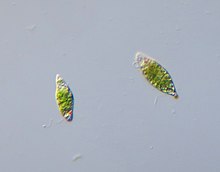

The species Euglena gracilis has been used extensively in the laboratory as a model organism.[4]
Most species of Euglena have photosynthesizing chloroplasts within the body of the cell, which enable them to feed by autotrophy, like plants. However, they can also take nourishment heterotrophically, like animals. Since Euglena have features of both animals and plants, early taxonomists, working within the Linnaean two-kingdom system of biological classification, found them difficult to classify.[5][6] It was the question of where to put such "unclassifiable" creatures that prompted Ernst Haeckel to add a third living kingdom (a fourth kingdom in toto) to the Animale, Vegetabile (and Lapideum meaning Mineral) of Linnaeus: the Kingdom Protista.[7]
Form and function
Reproduction
Euglena reproduce asexually through binary fission, a form of cell division. Reproduction begins with the mitosis of the cell nucleus, followed by the division of the cell itself. Euglena divide longitudinally, beginning at the front end of the cell, with the duplication of flagellar processes, gullet and stigma. Presently, a cleavage forms in the anterior, and a V-shaped bifurcation gradually moves toward the posterior, until the two halves are entirely separated.[21]
Reports of sexual conjugation are rare, and have not been substantiated.[22]
Historical background and early classification

Species of Euglena were among the first protists to be seen under the microscope.
In 1674, in a letter to the Royal Society, the Dutch pioneer of microscopy Antoni van Leeuwenhoek wrote that he had collected water samples from an inland lake, in which he found "animalcules" that were "green in the middle, and before and behind white." Clifford Dobell regards it as "almost certain" that these were Euglena viridis, whose "peculiar arrangement of chromatophores...gives the flagellate this appearance at low magnification."[23]
Twenty-two years later, John Harris published a brief series of "Microscopical Observations" reporting that he had examined "a small Drop of the Green Surface of some Puddle-Water" and found it to be "altogether composed of Animals of several Shapes and Magnitudes." Among them, were "oval creatures whose middle part was of a Grass Green, but each end Clear and Transparent," which "would contract and dilate themselves, tumble over and over many times together, and then shoot away like Fish."[24]
In 1786, O.F. Müller gave a more complete description of the organism, which he named Cercaria viridis, noting its distinctive color and changeable body shape. Müller also provided a series of illustrations, accurately depicting the undulating, contractile movements (metaboly) of Euglena's body.[25]

In 1830, C. G. Ehrenberg renamed Müller's Cercaria Euglena viridis, and placed it, in keeping with the short-lived system of classification he invented, among the Polygastrica in the family Astasiaea: multi-stomached creatures with no alimentary canal, variable body shape but no pseudopods or lorica.[26][27] By making use of the newly invented achromatic microscope,[28] Ehrenberg was able to see Euglena's eyespot, which he correctly identified as a "rudimentary eye" (although he reasoned, wrongly, that this meant the creature also had a nervous system). This feature was incorporated into Ehrenberg's name for the new genus, constructed from the Greek roots "eu-" (well, good) and glēnē (eyeball, socket of joint).[29]
Ehrenberg did not notice Euglena's flagella, however. The first to publish a record of this feature was Félix Dujardin, who added "filament flagelliforme" to the descriptive criteria of the genus in 1841.[30] Subsequently, the class Flagellata (Cohn, 1853) was created for creatures, like Euglena, possessing one or more flagella. While "Flagellata" has fallen from use as a taxon, the notion of using flagella as a phylogenetic criterion remains vigorous.[31]
Recent phylogeny and classification

In 1881, Georg Klebs made a primary taxonomic distinction between green and colorless flagellate organisms, separating photosynthetic from heterotrophic euglenoids. The latter (largely colorless, shape-changing uniflagellates) were divided among the Astasiaceae and the Peranemaceae, while flexible green euglenoids were generally assigned to the genus Euglena.[32]
As early as 1935, it was recognized that this was an artificial grouping, however convenient.[33] In 1948, Pringsheim affirmed that the distinction between green and colorless flagellates had no taxonomic justification, although he acknowledged its practical appeal. He proposed something of a compromise, placing colorless, saprotrophic euglenoids in the genus Astasia, while allowing some colorless euglenoids to share a genus with their photosynthesizing cousins, provided they had structural features that proved common ancestry. Among the green euglenoids themselves, Pringsheim recognized the close kinship of some species of Phacus and Lepocinclis with some species of Euglena.[32]
The idea of classifying the euglenoids by their manner of nourishment was finally abandoned in the 1950s, when A. Hollande published a major revision of the phylum, grouping organisms by shared structural features, such as the number and type of flagella.[34] If any doubt remained, it was dispelled in 1994, when genetic analysis of the non-photosynthesizing euglenoid Astasia longa confirmed that this organism retains sequences of DNA inherited from an ancestor that must have had functioning chloroplasts.[35]
In 1997, a morphological and molecular study of the Euglenozoa put Euglena gracilis in close kinship with the species Khawkinea quartana, with Peranema trichophorum basal to both.[36] Two years later, a molecular analysis showed that E. gracilis was, in fact, more closely related to Astasia longa than to certain other species recognized as Euglena. In 2015, Dr Ellis O'Neill and Professor Rob Field have sequenced the transcriptome of Euglena gracilis, which provides information about all of the genes that the organism is actively using. They found that Euglena gracilis has a whole host of new, unclassified genes which can make new forms of carbohydrates and natural products.[37][38]
The venerable Euglena viridis was found to be genetically closer to Khawkinea quartana than to the other species of Euglena studied.[34] Recognizing the polyphyletic nature of the genus Euglena, Marin et al. (2003) have revised it to include certain members traditionally placed in Astasia and Khawkinea.[14]
Human consumption
The taste of powdered euglena is described as dried sardine flakes, and contains minerals, vitamins and docosahexaenoic, an omega-3 acid. The powder is used as ingredient in other foods.[39] Kemin Industries sells a euglena nutraceutical supplement ingredient featuring dried Euglena gracilis with high levels of beta glucan.[40]
Feedstock for biofuel production
The lipid content of Euglena (mainly wax esters) is seen as a promising feedstock for production of biodiesel and jet fuel.[41] Under the aegis of Itochu, a start-up company called Euglena Co., Ltd. has completed a refinery plant in Yokohama in 2018, with a production capacity of 125 kiloliters of bio jet fuel and biodiesel per year.[42][43]